
A 3D modeling tool that doesn't watch your students
Free. No accounts. No data collection. No cloud. Just a real 3D modeling application your students download and use.
A 3D modeling tool built for classrooms
Spatio is designed to let K-12 students build, view, and share 3D models directly on a school computer. Simple to start with, powerful enough to stay useful as students advance.
Spatio will be standalone. It is not bundled into Heronix Suite, and there will be no license fee for schools or students. Any district, teacher, or student will be able to download and use it once it ships.
Because Spatio is designed as a free, self-contained tool, there are no accounts to create, no passwords to manage, and no student data flowing back to Heronix. The application runs locally.
Built from simple primitives — the kind of shapes students work with in Spatio.
What Spatio is — and isn't
Free to use
No cost for students, teachers, or districts. No premium tier. No "pro upgrade." The downloadable application will be the product.
No account required
No sign-up, no email capture, no student roster upload. Spatio will run locally. A student will download it and start building.
No data collection
Spatio will not send usage data back to Heronix. No telemetry, no analytics pings, no account-tied activity logs.
Not part of Suite
Spatio is a standalone application. It will not be a Suite module. Districts won't need a Heronix license to use it.
Not an LMS
Spatio won't grade student work, track assignments, or report to a teacher dashboard. It's a 3D modeling application, nothing more.
Not connected to PassTrack
Spatio will be a completely separate application from Heronix PassTrack and the Suite. They won't share data, accounts, or infrastructure.
Inside Spatio Studio
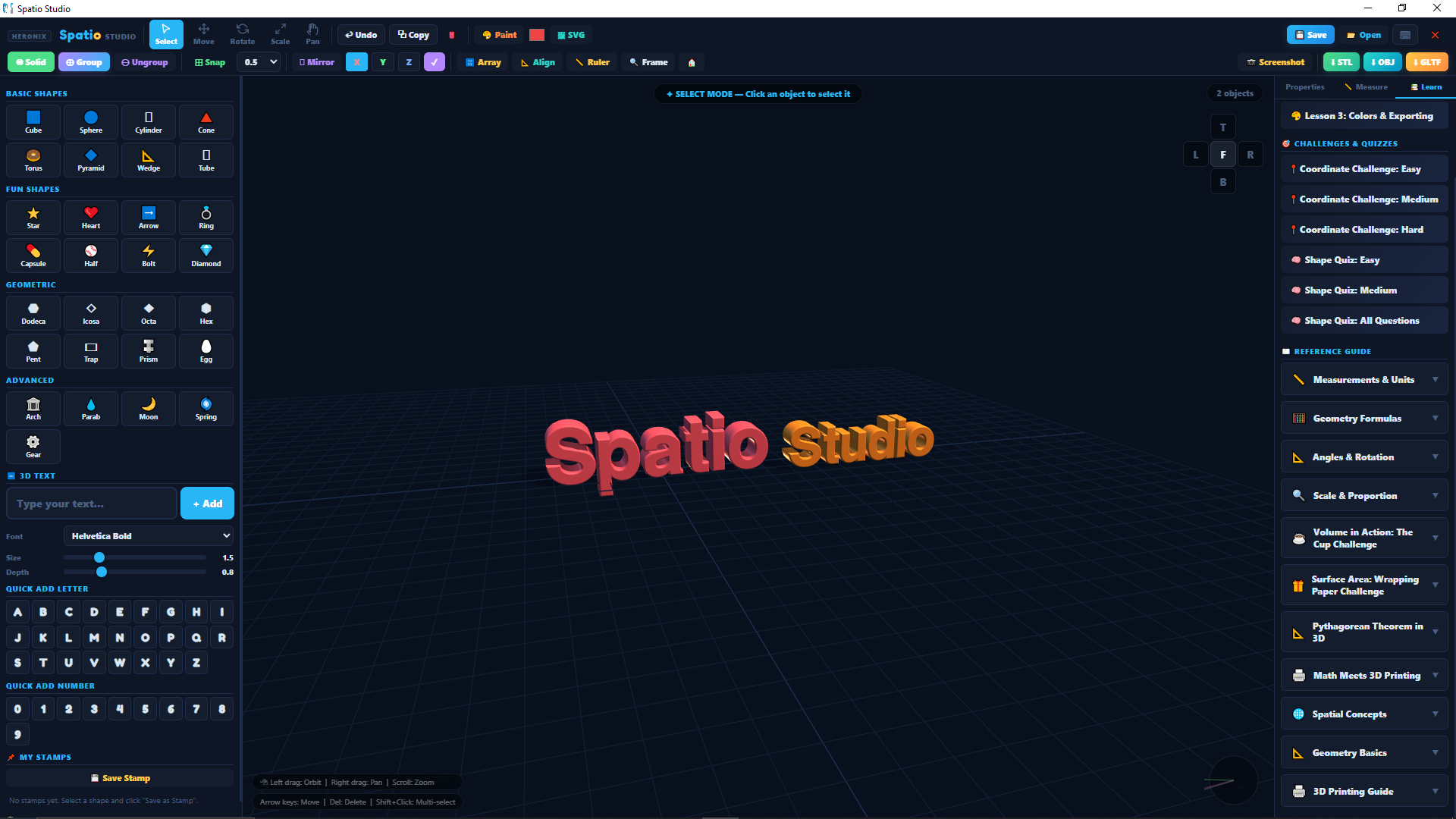
A quick look at the interface students use: a shape library on the left, the 3D scene viewport in the middle, and a quest panel on the right with built-in challenges and learning concepts.
Screenshot from the current build. The final UI may change before release.
What teachers do with Spatio
Eight concrete classroom use cases grounded in what Spatio actually does.
Geometry made tangible
Students build shapes and watch the formulas update live. Volume, surface area, edge lengths, and angles recalculate as dimensions change. Measurements toggle between metric and imperial on the fly, so the same triangle can be worked in centimeters or inches without leaving the scene.
3D printing as the deliverable
Export to STL and a phone stand a student designed in class becomes an object on the printer bed. The lesson ends with a physical artifact students can hold, not a screenshot in a slide deck.
Coordinate system practice
Place a cube at (4, 2, -3). Rotate it 45° around the Y axis. Built-in coordinate challenges drill positive and negative octants and 3D transformations using the same coordinate system the application runs on internally.
Density, mass, and material science
Pick from 12 materials — PLA, ABS, aluminum, water, ice, wood, and more — and Spatio computes the mass of the object from its volume and the material's density. Drop a hollow sphere into the simulated water tank and find out whether it floats.
Boolean operations and constructive solid geometry
Subtract a cylinder from a box to cut a hole. Union two shapes to make a compound piece. Intersect two solids to keep only the overlap. Students build complex geometry from primitives and boolean operations — the way CAD engineers do.
Cross-sections and structural thinking
Slice through a shape to see its interior. Compare cross-sections of different solids at the same height. Students reason about hollow versus solid construction — and about how a 3D printer actually lays down material layer by layer.
Built-in lessons and challenges
Spatio ships with three guided lessons and a library of coordinate quizzes. Teachers assign them directly from inside the application — no separate LMS, no login flow, no third-party courseware to license.
Cross-curricular use
A chess piece for a literature unit. A planet model for a solar system lesson. A phone stand for an engineering design challenge. A geometric sculpture for art class. The same tool fits math, science, art, engineering, and literature with no configuration switch.
Built without distractions
No ads. No notifications. No upgrade prompts. No social feeds. No telemetry. Spatio opens, builds, saves, exports. That's the whole experience.
Get notified when Spatio ships
Spatio will be available for download soon. Leave us a note and we'll email you when the build is ready.
Get notified For teachers